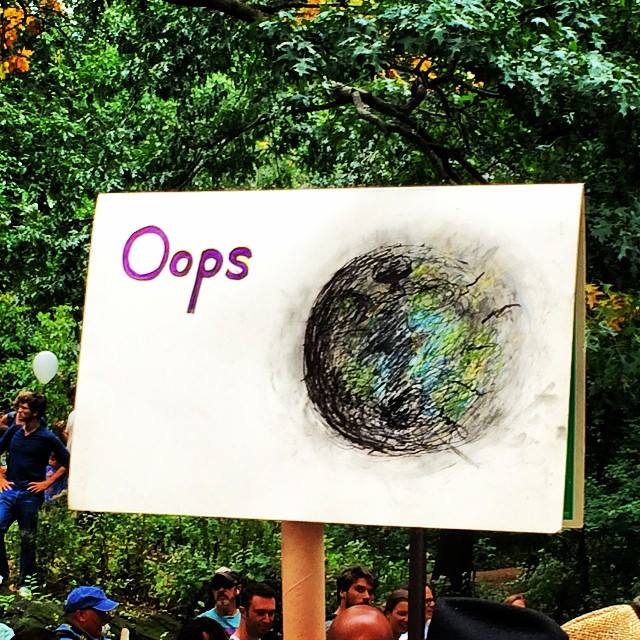
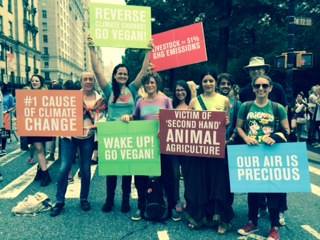
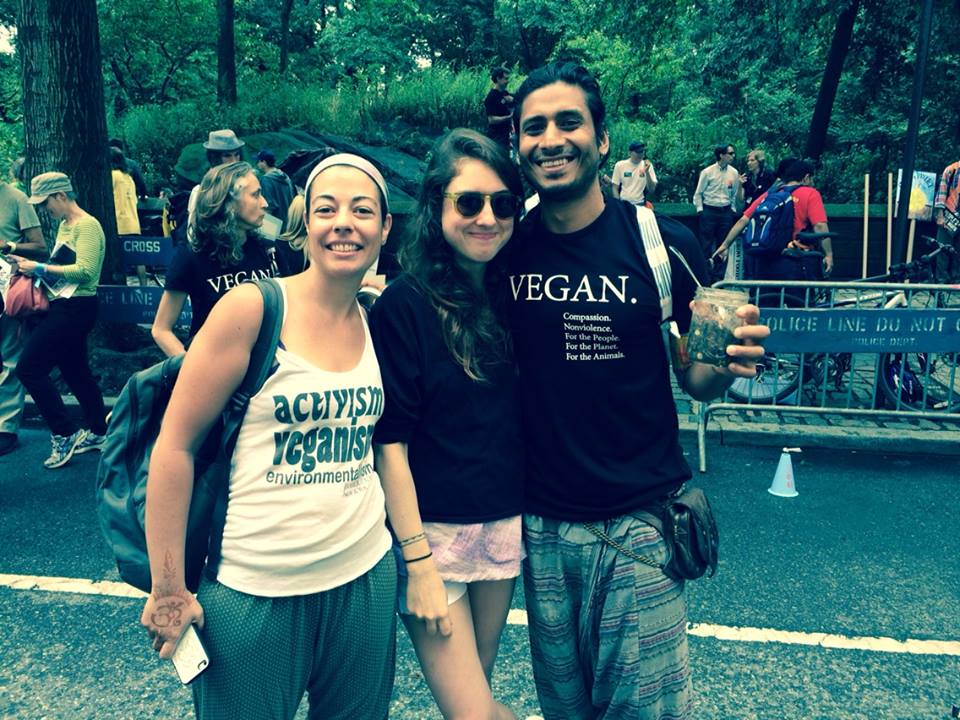
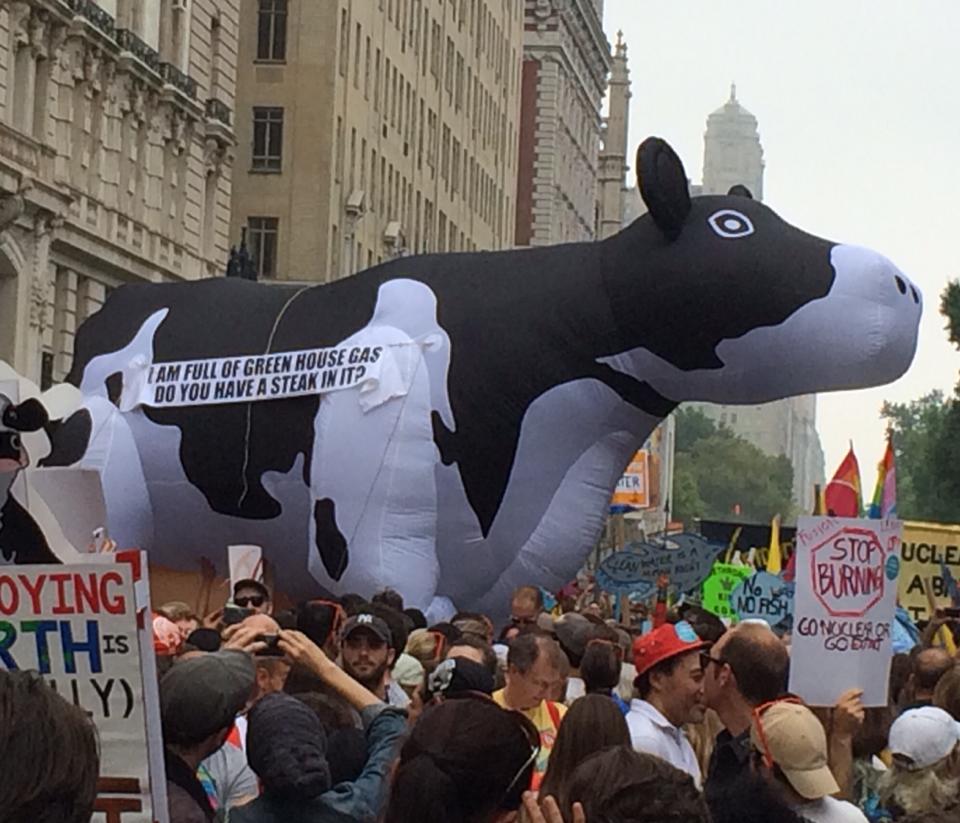
This past Sunday, September 21st, 2014, I joined 400,00 others in the People’s Climate March in NYC. It was the largest of it’s kind, and amazing that so many people care about the future of this Earth we live on. Unfortunately, it was covered by only one news network, and only for about 23 seconds.
One of the reasons for the lack of coverage is very same reason why I marched: our major “environmental” organizations, like GreenPeace, 350.org, etc., refuse to acknowledge the biggest cause of our environmental decline: the animal agriculture industry. The farming industry in the United States essentially runs our government. This industry has so much power in our country, that even high profile people like former Vice-President Al Gore, are afraid to talk about it. In fact, animal rights and environmental activists are the #1 offenders on the FBI watch list, rather than the actual bad guys.
It is estimated that at the rate our population is growing and the amount our word eats animal based food, we will only be around another 50 years or so. In 50 years I will be 84…I’d like to see the world last a bit longer than that! The farming industry is not only affecting the air and water we need to survive, but also killing off our natural wildlife. If you get excited when you see a fox or bear while on a hike, you better take advantage of it now, because natural wildlife won’t be here much longer.
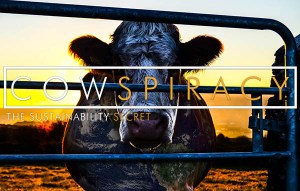
The first is to educate yourself: watch the movie Cowspiracy. The movie highlights the fact that the largest cause of environmental decline is being hidden by all major environmental organizations, and our government. You can learn more about it here: http://cowspiracy.com/.
#2: Eat a plant based diet. It is completely possible to live a healthy, happy life on a vegan diet. Even if you are pregnant and/or raising children. Milk produced by cows is for their calfs to grow up into big strong cows! And if you love ice cream and cheese, you can get amazing tasting nut based ice cream or tapioca based cheese – it tastes the same, I swear! And you don’t even have to eat soy if you don’t want to! Sharon Gannon, co-founder of Jivamukti Yoga School, just released a new cook book called Simple Recipes for Joy. There are over 200 vegan recipes in the book, even things like meatballs and spaghetti and manhattan clam chowder! I happened to have helped make the food in pictures in the book and tested recipes before publishing! You can order it here: Simple Recipes for Joy
Please feel free to comment or ask questions. Here are some facts that are posted on the Cowspiracy website, all completely research based. I have a copy of the Cowspiracy movie if you are in the NY area and want to borrow it.
Director’s Note:
The science and research done on the true impacts of animal agriculture is always growing. The statistics used in the film were based off the information below.
We will continually update this list with further resources as they become available.
Although there may be fluctuations in numbers from year to year and from researcher to researcher, the fact remains that animal agriculture, as a whole, requires tremendous amounts of resources and is a leader in environmental degradation.
Animal agriculture is responsible for 51 percent of greenhouse gas emissions, more than all transportation combined. [i]
Fao.org. Spotlight: Livestock impacts on the environment.
http://www.fao.org/ag/magazine/0612sp1.htm
Transportation is responsible for 18% of all greenhouse gas emissions.
Greenhouse gas emissions from this sector primarily involve fossil fuels burned for road, rail, air, and marine transportation.
Environmental Protection Agency. “Global Emissions.”
http://www.epa.gov/climatechange/ghgemissions/global.html
Livestock and their byproducts actually account for at least 32,000 million tons of carbon dioxide (CO2) per year, or 51% of all worldwide greenhouse gas emissions.
Goodland, R Anhang, J. “Livestock and Climate Change: What if the key actors in climate change were pigs, chickens and cows?”
WorldWatch, November/December 2009. Worldwatch Institute, Washington, DC, USA. Pp. 10–19.
http://www.worldwatch.org/node/6294
Methane is 25-100 times more destructive than CO2.
“Improved Attribution of Climate Forcing to Emissions.” Science Magazine.
http://www.sciencemag.org/content/326/5953/716.figures-only
Methane has a global warming power 86 times that of CO2.
NASA. “Methane: Its Role as a Greenhouse Gas.” Jet Propulsion Laboratory.
http://www.jpl.nasa.gov/education/pdfs/podest_ghg.pdf
Livestock is responsible for 65% of all emissions of nitrous oxide – a greenhouse gas 296x more destructive than carbon dioxide and which stays in the atmosphere for 150 years.
“Livestock’s Long Shadow: Environmental Issues and Options.” Food and Agriculture Organization of the United Nations. 2006.
http://www.fao.org/docrep/010/a0701e/a0701e00.htm
Fracking (hydraulic fracturing) water use ranges from 70-140 billion gallons annually.
“Draft Plan to Study the Potential Impacts of Hydraulic Fracturing on Drinking Water Resources.” EPA Office of Research and Development. United States Environmental Protection Agency, 2011.
http://www2.epa.gov/sites/production/files/documents/HFStudyPlanDraft_SAB_020711.pdf
Animal agriculture use ranges from 34-76 trillion gallons of water annually. [ii]
Pimentel, David, et al. “Water Resources: Agricultural And Environmental Issues.” BioScience 54, no. 10 (2004): 909-18.
http://bioscience.oxfordjournals.org/content/54/10/909.full
Barber, N.L., “Summary of estimated water use in the United States in 2005: U.S. Geological Survey Fact Sheet 2009–3098.”
http://pubs.usgs.gov/fs/2009/3098/
Agriculture is responsible for 80-90% of US water consumption.
“USDA ERS – Irrigation & Water Use.” United States Department of Agriculture Economic Research Service. 2013.
http://www.ers.usda.gov/topics/farm-practices-management/irrigation-water-use/background.aspx
Growing feed crops for livestock consumes 56% of water in the US.
Jacobson, Michael F. “More and Cleaner Water.” In Six Arguments for a Greener Diet: How a More Plant-based Diet Could save Your Health and the Environment.
Washington, DC: Center for Science in the Public Interest, 2006.
http://www.cspinet.org/EatingGreen/pdf/arguments4.pdf
One hamburger requires 660 gallons of water to produce – the equivalent of 2 months’ worth of showers. [iii]
Catanese, Christina. “Virtual Water, Real Impacts.” Greenversations: Official Blog of the U.S. EPA. 2012.
http://blog.epa.gov/healthywaters/2012/03/virtual-water-real-impacts-world-water-day-2012/
“50 Ways to Save Your River.” Friends of the River.
http://www.friendsoftheriver.org/site/PageServer?pagename=50ways
2,500 gallons of water are needed to produce 1 pound of beef.
Robbins, John. “2,500 Gallons, All Wet?” EarthSave
http://www.earthsave.org/environment/water.htm
Meateater’s Guide to Climate Change & Health.” Environmental Working Group.
http://www.ewg.org/meateatersguide/interactive-graphic/water/
“Water Footprint Assessment.” University of Twente, the Netherlands.
http://www.waterfootprint.org
Oppenlander, Richard A. Food Choice and Sustainability: Why Buying Local, Eating Less Meat, and Taking Baby Steps Won’t Work. Minneapolis, MN: Langdon Street, 2013. Print
477 gallons of water are required to produce 1 pound of eggs; 900 gallons of water are needed for cheese.
“Meateater’s Guide to Climate Change & Health.” Environmental Working Group.
http://www.ewg.org/meateatersguide/interactive-graphic/water/
1,000 gallons of water are required to produce 1 gallon of milk.
“Water trivia facts.” United States Environmental Protection Agency.
http://water.epa.gov/learn/kids/drinkingwater/water_trivia_facts.cfm#_edn11
5% of water in the US is used by private homes.
55% of water in the US is used for animal agriculture.
Jacobson, Michael F. “More and Cleaner Water.” In Six Arguments for a Greener Diet: How a More Plant-based Diet Could save Your Health and the Environment. Washington, DC: Center for Science in the Public Interest, 2006.
http://www.cspinet.org/EatingGreen/pdf/arguments4.pdf
Oppenlander, Richard A. Food Choice and Sustainability: Why Buying Local, Eating Less Meat, and Taking Baby Steps Won’t Work. Minneapolis, MN: Langdon Street, 2013. Print.
The meat and dairy industries combined use nearly 1/3 (29%) of all the fresh water in the world today.
“Freshwater Abuse and Loss: Where Is It All Going?” Forks Over Knives.
http://www.forksoverknives.com/freshwater-abuse-and-loss-where-is-it-all-go
Livestock covers 45% of the earth’s total land.
Thornton, Phillip, Mario Herrero, and Polly Ericksen. “Livestock and Climate Change.” Livestock Exchange, no. 3 (2011).
Click to access IssueBrief3.pdf
Animal agriculture is the leading cause of species extinction, ocean dead zones, water pollution [iv], and habitat destruction.
Oppenlander, Richard A. Food Choice and Sustainability: Why Buying Local, Eating Less Meat, and Taking Baby Steps Won’t Work. . Minneapolis, MN : Langdon Street, 2013. Print.
“What’s the Problem?” United States Environmental Protection Agency.
http://www.epa.gov/region9/animalwaste/problem.html
“Livestock’s Long Shadow: Environmental Issues and Options.” Food and Agriculture Organization of the United Nations. 2006.
http://www.fao.org/docrep/010/a0701e/a0701e00.htm
“Fire Up the Grill for a Mouthwatering Red, White, and Green July 4th.” Worldwatch Institute.
http://www.worldwatch.org/fire-grill-mouthwatering-red-white-and-green-july-4th
Oppenlander, Richard A. “Biodiversity and Food Choice: A Clarification.” Comfortably Unaware. 2012
http://comfortablyunaware.com/blog/biodiversity-and-food-choice-a-clarification/
“Risk Assessment Evaluation for Concentrated Animal Feeding Operations.” U.S. Environmental Protection Agency – Office of Research and Development. 2004.
http://nepis.epa.gov/Exe/ZyPURL.cgi?Dockey=901V0100.txt
Every minute, 7 million pounds of excrement are produced by animals raised for food in the US.
This doesn’t include the animals raised outside of USDA jurisdiction or in backyards, or the billions of fish raised in aquaculture settings in the US. [v]
“What’s the Problem?” United States Environmental Protection Agency.
http://www.epa.gov/region9/animalwaste/problem.html
“How To Manage Manure.” Healthy Landscapes.
http://www.uri.edu/ce/healthylandscapes/livestock/how_manure_overall.htm
335 million tons of “dry matter” is produced annually by livestock in the US.
“FY-2005 Annual Report Manure and Byproduct Utilization National Program 206.”
USDA Agricultural Research Service. 2008.
http://www.ars.usda.gov/research/programs/programs.htm?np_code=206&docid=13337
A farm with 2,500 dairy cows produces the same amount of waste as a city of 411,000 people. [vi]
“Risk Assessment Evaluation for Concentrated Animal Feeding Operations.” U.S. Environmental Protection Agency – Office of Research and Development. 2004.
http://nepis.epa.gov/Exe/ZyPURL.cgi?Dockey=901V0100.txt
3/4 of the world’s fisheries are exploited.
“Overfishing: A Threat to Marine Biodiversity.” UN News Center.
http://www.un.org/events/tenstories/06/story.asp?storyid=800
“General Situation of World Fish Stocks.” United Nations Food and Agriculture Organization (FAO).
http://www.fao.org/newsroom/common/ecg/1000505/en/stocks.pdf
90 million tons of fish are pulled from our oceans each year. [vii]
“World Review of Fisheries and Aquaculture.” UNITED NATIONS FOOD AND AGRICULTURE ORGANIZATION (FAO). 2012.
http://www.fao.org/docrep/016/i2727e/i2727e01.pdf
For every 1 pound of fish caught, an average of 5 pounds of unintended marine species are caught and discarded as by-kill. [viii]
“Discards and Bycatch in Shrimp Trawl Fisheries.”
UNITED NATIONS FOOD AND AGRICULTURE ORGANIZATION (FAO).
http://www.fao.org/docrep/W6602E/w6602E09.htm
As many as 40% (63 billion pounds) of fish caught globally every year are discarded.
Goldenberg, Suzanne. “America’s Nine Most Wasteful Fisheries Named.” The Guardian.
http://www.theguardian.com/environment/2014/mar/20/americas-nine-most-wasteful-fisheries-named
Scientists estimate as many as 650,000 whales, dolphins and seals are killed every year by fishing vessels.
Goldenberg, Suzanne. “America’s Nine Most Wasteful Fisheries Named.” The Guardian.
http://www.theguardian.com/environment/2014/mar/20/americas-nine-most-wasteful-fisheries-named
100 million tons of fish are caught annually.
Montaigne, fen. “Still waters: The global fish crisis.” National Geographic.
http://ocean.nationalgeographic.com/ocean/global-fish-crisis-article/
Fish catch peaks at 85 million tons.
“World Review of Fisheries and Aquaculture.” UNITED NATIONS FOOD AND AGRICULTURE ORGANIZATION (FAO). 2012.
http://www.fao.org/docrep/016/i2727e/i2727e01.pdf
Animal agriculture is responsible for 91% of Amazon destruction.
Oppenlander, Richard A. Food Choice and Sustainability: Why Buying Local, Eating Less Meat, and Taking Baby Steps Won’t Work. . Minneapolis, MN : Langdon Street, 2013. Print.
Margulis, Sergio. Causes of Deforestation of the Brazilian Rainforest. Washington: World Bank Publications, 2003.
https://openknowledge.worldbank.org/handle/10986/15060
1-2 acres of rainforest are cleared every second.
“Avoiding Unsustainable Rainforest Wood.” Rainforest Relief.
http://www.rainforestrelief.org/What_to_Avoid_and_Alternatives/Rainforest_Wood.html
Facts about the rainforest.
http://www.savetherainforest.org/savetherainforest_007.htm
Rainforest facts.
http://www.rain-tree.com/facts.htm
The leading causes of rainforest destruction are livestock and feedcrops.
“Livestock impacts on the environment.” Food and agriculture organization of the United Nations (fao). 2006.
http://www.fao.org/ag/magazine/0612sp1.htm
110 plant, animal and insect species are lost every day due to rainforest destruction.
“Rainforest statistics and facts.” Save the amazon.
http://www.savetheamazon.org/rainforeststats.htm
Oppenlander, Richard A. Food Choice and Sustainability: Why Buying Local, Eating Less Meat, and Taking Baby Steps Won’t Work. Minneapolis, MN: Langdon Street, 2013. Print.
26 million rainforest acres have been cleared for palm oil production. [ix]
“Indonesia: palm oil expansion unaffected by forest moratorium.” USDA Foreign Agricultural Service. 2013.
http://www.pecad.fas.usda.gov/highlights/2013/06/indonesia/
136 million rainforest acres cleared for animal agriculture.
“AMAZON DESTRUCTION.” MONGA BAY.
http://rainforests.mongabay.com/amazon/amazon_destruction.html
1,100 activists have been killed in Brazil in the past 20 years. [x]
Batty, David. “Brazilian faces retrial over murder of environmental activist nun in Amazon.” The Guardian. 2009.
http://www.theguardian.com/world/2009/apr/08/brazilian-murder-dorothy-stang
Cows produce 150 billion gallons of methane per day. [xi]
Ross, Philip. “Cow farts have ‘larger greenhouse gas impact’ than previously thought; methane pushes climate change.” International Business Times. 2013.
http://www.ibtimes.com/cow-farts-have-larger-greenhouse-gas-impact-previously-thought-methane-pushes-climate-change-1487502
130 times more animal waste than human waste is produced in the US – 1.4 billion tons from the meat industry annually. 5 tons of animal waste is produced for every person. [xii]
Animal agriculture: waste management practices. United States General Accounting Office.
http://www.gao.gov/archive/1999/rc99205.pdf
2-5 acres of land are used per cow.
Oppenlander, Richard A. Food Choice and Sustainability: Why Buying Local, Eating Less Meat, and Taking Baby Steps Won’t Work.
Minneapolis, MN: Langdon Street, 2013. Print.
The average American consumes 209 pounds of meat per year.
Haney, Shaun. “How much do we eat?” Real agriculture. 2012. (276 lbs)
http://www.realagriculture.com/2012/05/how-much-meat-do-we-eat/
“US meat, poultry production & consumption” American Meat Institute. 2009. (233.9 lbs)
http://www.meatami.com/ht/a/GetDocumentAction/i/48781
Bernard, Neal. “Do we eat too much?” Huffington Post. (200 lbs)
http://www.huffingtonpost.com/neal-barnard-md/american-diet-do-we-eat-too-much_b_805980.html
Nearly half of the contiguous US is devoted to animal agriculture. [xiii]
30% of the Earth’s entire land surface is used by the livestock sector.
Versterby, Marlow; Krupa, Kenneth. “Major uses of land in the United States.” Updated 2012. USDA Economic Research Service.
http://www.ers.usda.gov/publications/sb-statistical-bulletin/sb-973.aspx#.VAoXcl7E8dt
“Rearing cattle produces more greenhouse gases than driving cars, UN report warns.”
UN News Centre, 2006.
http://www.un.org/apps/news/story.asp?newsID=20772
1/3 of the planet is desertified due to livestock.
“UN launches international year of deserts and desertification.”
UN news centre, 2006.
http://www.un.org/apps/news/story.asp?NewsID=17076#.VAodM17E8ds
Oppenlander, Richard A. Less Meat, and Taking Baby Steps Won’t Work. Minneapolis, MN : Langdon Street, 2013. Print.
World population in 1812: 1 billion; 1912: 1.5 billion; 2012: 7 billion.
“Human numbers through time.” Nova science programming.
http://www.pbs.org/wgbh/nova/worldbalance/numb-nf.html
70 billion farmed animals are reared annually worldwide. More than 6 million animals are killed for food every hour.
A well-fed world. factory farms.
http://www.awfw.org/factory-farms/
Oppenlander, Richard A. Less Meat, and Taking Baby Steps Won’t Work. Minneapolis, MN : Langdon Street, 2013. Print.
Throughout the world, humans drink 5.2 billion gallons of water and eat 21 billion pounds of food each day.
Based on rough averages of 0.75 gallons of water and 3 lbs of food per day.
Worldwide, cows drink 45 billion gallons of water and eat 135 billion pounds of food each day.
Based on rough average of 30 gallons of water and 90 lbs of feed per day.
Land required to feed 1 person for 1 year:
Vegan: 1/6th acre
Vegetarian: 3x as much as a vegan
Meat eater: 18x as much vegan
“Our food our future.” Earthsave.
Click to access ofof2006.pdf
1.5 acres can produce 37,000 pounds of plant-based food.
1.5 acres can produce 375 pounds of meat.
Oppenlander, Richard A. Less Meat, and Taking Baby Steps Won’t Work. Minneapolis, MN : Langdon Street, 2013. Print.
A person who follows a vegan diet uses 50% less carbon dioxide, 1/11th oil, 1/13th water, and 1/18th land compared to a meat-eater.
CO2: “Dietary greenhouse gas emissions of meat-eaters, fish-eaters, vegetarians and vegans in the UK.” Climactic change, 2014.
http://link.springer.com/article/10.1007%2Fs10584-014-1169-1/fulltext.html
Oil, water: “Sustainability of meat-based and plant-based diets and the environment.”
The American Journal of Clinical Nutrition, 2003.
http://ajcn.nutrition.org/content/78/3/660S.full
Land: “Our food our future.” Earthsave.
Click to access ofof2006.pdf
Each day, a person who eats a vegan diet saves 1,100 gallons of water, 45 pounds of grain, 30 sq ft of forested land, 20 lbs CO2 equivalent, and one animal’s life. [xiv]
“Water Footprint Assessment.” University of Twente, the Netherlands.
http://www.waterfootprint.org
Oppenlander, Richard A. Less Meat, and Taking Baby Steps Won’t Work. Minneapolis, MN : Langdon Street, 2013. Print.
“Measuring the daily destruction of the world’s rainforests.” Scientific American, 2009.
http://www.scientificamerican.com/article/earth-talks-daily-destruction/
“Dietary greenhouse gas emissions of meat-eaters, fish-eaters, vegetarians and vegans in the UK.” Climactic change, 2014.
http://link.springer.com/article/10.1007%2Fs10584-014-1169-1/fulltext.html
“Meat eater’s guide to climate change and health.” The Environmental Working Group.
http://static.ewg.org/reports/2011/meateaters/pdf/methodology_ewg_meat_eaters_guide_to_health_and_climate_2011.pdf







 april dechagas