We live in a technological world, which isn’t necessarily a bad thing! We have become interconnected with other human beings in ways most of us couldn’t have ever imagined! I wouldn’t be able to connect with most of you if not for this technological world! But there should be a happy medium…we cannot solely rely on technology, and we cannot go off to live in a cave somewhere to meditate all the time and ditch life (Bharati also spoke about this at Ananda Ashram this weekend)
Here are some thoughts on this by Thich Nhat Hanh, from his book The Sun My Heart:
“Meditators have always known that they must use their own eyes and the language of their own times to express their insight. Wisdom is a living stream, not an icon to be preserved in a museum. Only when a practitioner finds the spring of wisdom in his or her own life can it flow to future generations. All of us must keep the torch of wisdom glowing in order to light the path ahead.
Our insight and our language are inseparable from the times in which we live. For many years, the East followed the West down the path of technological and material development, to the point of neglecting its own spiritual values. In our world, technology is the main force behind economics and politics, but scientists in the West have begun to see something similar to what the spiritual disciplines of the East discovered long ago. If we can survive our times, the gap that separates science and spirituality will close, and East and West will meet one another on the path to discover true mind. We can start working towards convergence right now, using our own daily mindful lives.”
If you do too much too quickly, your fire will burn out. If you take on more then you can handle, your fire will burn out. If you try to shove your knee to your ankle in agnistambhasana before it’s ready, your fire (and your knee!) will burn out! Take things slow, breath deep and take it all in. Practice and all is coming.
Anjaneya was the son
of Vayu, the wind God, and Anjana, a mortal woman. Because of his demi-God
status, Anjaneya had superpowers – he could grow really large, and shrink
really small, he had super-strength and could leap to great heights. Because of
this, Anajaneya was unintentionally a bit of a troublemaker as a child.
One morning, Anjaneya
saw the sun in the sky and thought it was a mango. He leapt up to eat the sun,
but before he could, Surya, the sun god, threw a lightning bolt that hit
Anjaneya in the jaw (hanu in Sanskrit) and he fell to the earth.
The Gods and Goddess
were in distress. This little guy with all of his powers could cause the
destruction of the world. They agreed to revive him, but with short-term
memory, so that he would never remember the powers he had. He was given the
nickname Hanumān,
in reference to his broken jaw, was sent to foster with Sugriva the monkey king
and was given the form of a monkey to fit in with his new family. Hanumān lived
most of his life with no knowledge of the true power he held within.
When Hanumān was grown, he met Rām
in the Dandaka forest and joined him on his journey to save Sītā from the evil demon Rāvaṇa.
After travelling for many days, they arrived at a large ocean that was
separating them from the island of Lanka, where Sītā was being held. Hanumān was distraught and felt defeated.
They had come all this way, and all he wanted was to help his friend Rām. He
was about to give up when his friend Jambavana, King of the Bears, whispered in
his ear that Hanumān was more powerful than he realized. With that subtle
reminder, Hanumān, out of pure love, devotion and joy for Sītā and Rām, and without thinking about tight
hamstrings, quadriceps or psoas muscles, leapt across the ocean to the island
of Lanka to save Sītā.
Most of
us are more capable that we realize, and we all have so much power within, it
is just clouded sometimes, by physical and/or emotional pain. We are all
stronger than we know, and can handle A LOT. Most of the time, when we finally
leap across what seems like a very large chasm of an ocean, we say to
ourselves, “Well, that wasn’t so bad!” On the other hand, sometimes we don’t
realize how powerful we actually are. That our thoughts, words and actions,
hold so much power, that we don’t realize how what we put out into the world
affects the other living beings around us.
Hanumānāsana requires a balance of strength, trust, ease, grace, and a bit of fearlessness. Rather than focusing on tightness and un-comfortableness of the āsana, you can return to the intention you set in the beginning of class. Offering the efforts of your practice to someone other than yourself is one way of bringing a sense of mindfulness into the practice. Let go of what is holding you back!
Hey guys! This is a special #mythmonday video shot from my retreat location in La Sierra Nevada de Santa Marta in Colombia, the largest coastal mountain range in the world! I’ll be telling the story of Pārvatī, but while I was here in Colombia I did some research on local indigenous mythology and found a description of a myhtological figure named La Madre Monte, Mother Mountain:
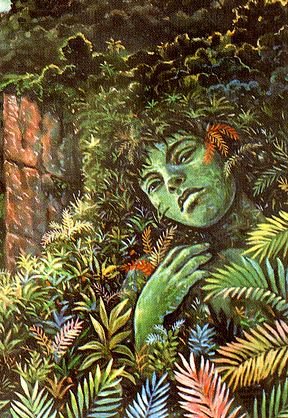
Madre monte (Mother Mountain) is a stout, elegant woman who wears moss and leaves and a green hat that conceals her face. She lives in dense jungle and supposedly bathes in rivers, causing flooding and heavy storms. Madre monte haunts those who steal others people’s land and casts plagues on cattle owners who usurp fields or ignore boundaries. She also dislikes unfaithful spouses, vagabonds and general mischief-makers and punishes them by placing insurmountable obstacles in their path when they walk through the jungle. They eventually fall asleep with exhaustion and do not wake for hours.
I found many of her attributes similar to those of yogic mythology, like Pārvatī, or her son Gaṇeśa. Check out the #mythmonday video below.
Pārvatī was born into royalty; her father Himavat was king of the Himalaya, who was also sometimes referred to as King Parvat. Pārvatī was named after her father, and her name translates to ‘Daughter of the Mountains’. She is the goddess of fertility (everything comes from the mountain, or Earth), love, devotion, but also of strength and power – just like a mountain! The alignment of tāḍāsana (mountain seat) exists within every single other āsana we come into during class. All the āsanas have the same physical alignment, they are just shaped different. Similarly, everything on this planet, living and inanimate, are made of the same elements, we are just shaped different. The mountain, or let’s say Earth, is also the connection between all of the other forms we come into. We come into the form of humans – warriors and sages and saints, of animals – dogs, monkeys, birds, frogs, fish, insects. We come into the form of flowers and trees. We come into the form of tools – compasses, plows, boats. The mountain (Earth) is the common factor. Everything on this planet, even what we think of as inanimate objects, comes from this earth. The practices of yoga – physical, spiritual and philosophical – teach us how to relate and connect to everyone and everything around us in a meaningful and supportive way.
This story is very much about ego. Kahola could not stand being corrected by his unborn son, and cursed him, causing a birth deformity. Aṣṭāvakra couldn’t stand the mistakes being made by Kahola and could not help but correct him from the womb. The supposed vedic scholars could not believe that someone who looked like Aṣṭāvakra could also be a vedic scholar and were embarrassed when he proved them wrong.
Similarly arm balances are also all about ego. Yes, they require strength and flexibility – both attributes we need in our everyday lives. But when we can all of a sudden come into an arm balance, it all of a sudden becomes our new social media profile pic or new party trick (don’t drink and yoga you guys!) And when we can’t do them, we are looking around the room comparing ourselves to those who can and wondering why we can’t. It’s all about ego, and none of that matters. You won’t all of a sudden become enlightened when you come into Aṣṭāvakrāsana the first time (wouldn’t that be nice!) There is a deeper meaning behind why we practice āsanas, and it’s not about circus tricks. Although this does not mean that you shouldn’t at least try and work your way up to the full asana. If you never try, nothing will ever change. We can say that nothing we do will make changes in the world, but if we don’t at least try, then DEFINITELY nothing will ever change. Be the change you want to see in the world.
Thousands of years
after Matsya the fish received the teachings of yoga from Shiva, he was
reincarnated as Matsyendra (sometimes also referred to as Matsyendranath),
which means Lord of the Fishes (matsya = fish, indra = lord, nath = refers to
Nath group).
Matsyendra was a Nath
Warrior, who was also a half man, half fish (a mer-man!) The Nath Warriors were
a power-hungry group of people during the 10th-14th centuries who would do
whatever it took to become more powerful – pillaging villages, tearing down
forests, destroying everything around them without giving a second thought to
the destruction they caused.
Matsyendra had heard
about this strange group of people who hung out in caves deep in the woods
meditating and contorting their bodies in all sorts of ways – and they also had
superpowers. These yogis, as they were called, could predict the future, become
invisible, levitate, had super-strength, could go a long time without food or
drink, had super-sonic hearing, and so much more. The Nath Warriors thought
that if they had all of these powers, they would be invincible and could take
over the world! So they took a break from destroying the world to study yoga.
Eventually they transformed and realized there was much more to life than
taking over the world. Through long and consistent practice (abhyāsa) but also
non-attachments to the results of yoga (vairāgyā) they found happiness, joy and
bliss, and became the Nath Yogis, rather than the Nath
Warriors.
Matsyendra shared
these physical yogic practices with Swami Svatmarama, who wrote them down, and
they were passed down to us in the form of the Hatha Yoga Pradīpikā. Each chapter of the HYP starts off with an invocation to the
Lord Shiva who was the first to pass down the teachings of yoga.
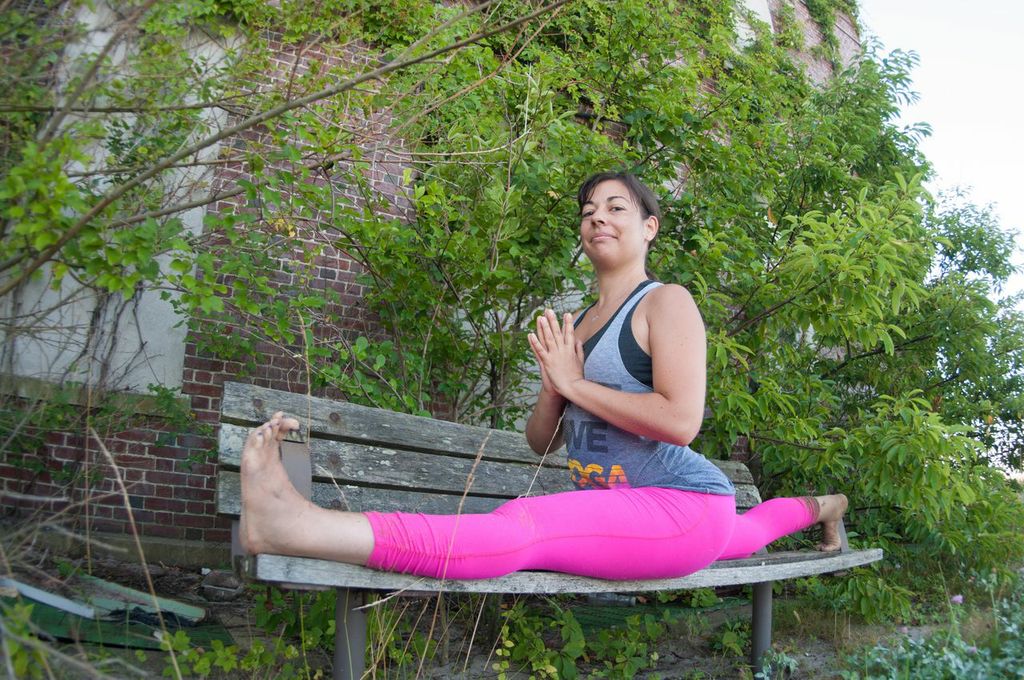
In an āsana class we take the form of Ardha Matsyendrāsana (sometimes referred to as seated spinal twist) as an homage to the lineage of teachers who passed down the teachings of yoga either directly or indirectly to us. The upper body represents the torso of a man, while the folded legs resemble the tail of a fish. This āsana is not only a twist, but also an outer hip opener (on the side you are twisting). It promotes spinal health and flexibility, and also stimulates our digestive function. We typically twist to the right first to allow food to move up the ascending colon, and then to the left down the descending colon.
I have the great privilege and humbling honor to lead this year’s annual Jivamukti Yoga Memorial Day Retreat at Ananda Ashram, located in Monroe, NY, May 24th – 27th 2019.
We will spend the weekend exploring asana and meditation, while diving deeper into spiritual teachings that can support our health, happiness, and sanity. Best of all, we will be doing it together in a beautiful place. This retreat is not only a gift to yourself, but to everyone you know, and to all beings.
Each day we will rise together for meditation and asana class, then meet again in the afternoons for further exploration through asana, study and song. We will enjoy delicious vegan meals prepared for us with love. There will also be opportunities to study Sanskrit with the amazingly gifted teacher Bharati, and to participate in the ashram’s acclaimed evening programs.
It is often impossible to move forward in a new way without first taking a step back. The retreat is an opportunity to get in touch with our Jivamukti lineage, part of which came through Ananda Ashram founder Shri Brahmananda Sarasvati. By unplugging from daily life, you have the opportunity to steep in your practice, and to suspend unhelpful cyclic thinking.
Semi-private accommodations $595, pre-register before May 1st $625 after May 1st
Dorm Room accommodations $535, pre-register before May 1st $565 after May 1st
Ananda Ashram in Monroe, New York, is a Yoga retreat and spiritual-educational center just over one hour from New York City, founded in 1964 by Shri Brahmananda Sarasvati (then Ramamurti S. Mishra, M.D.) as the country center of the Yoga Society of New York, Inc.
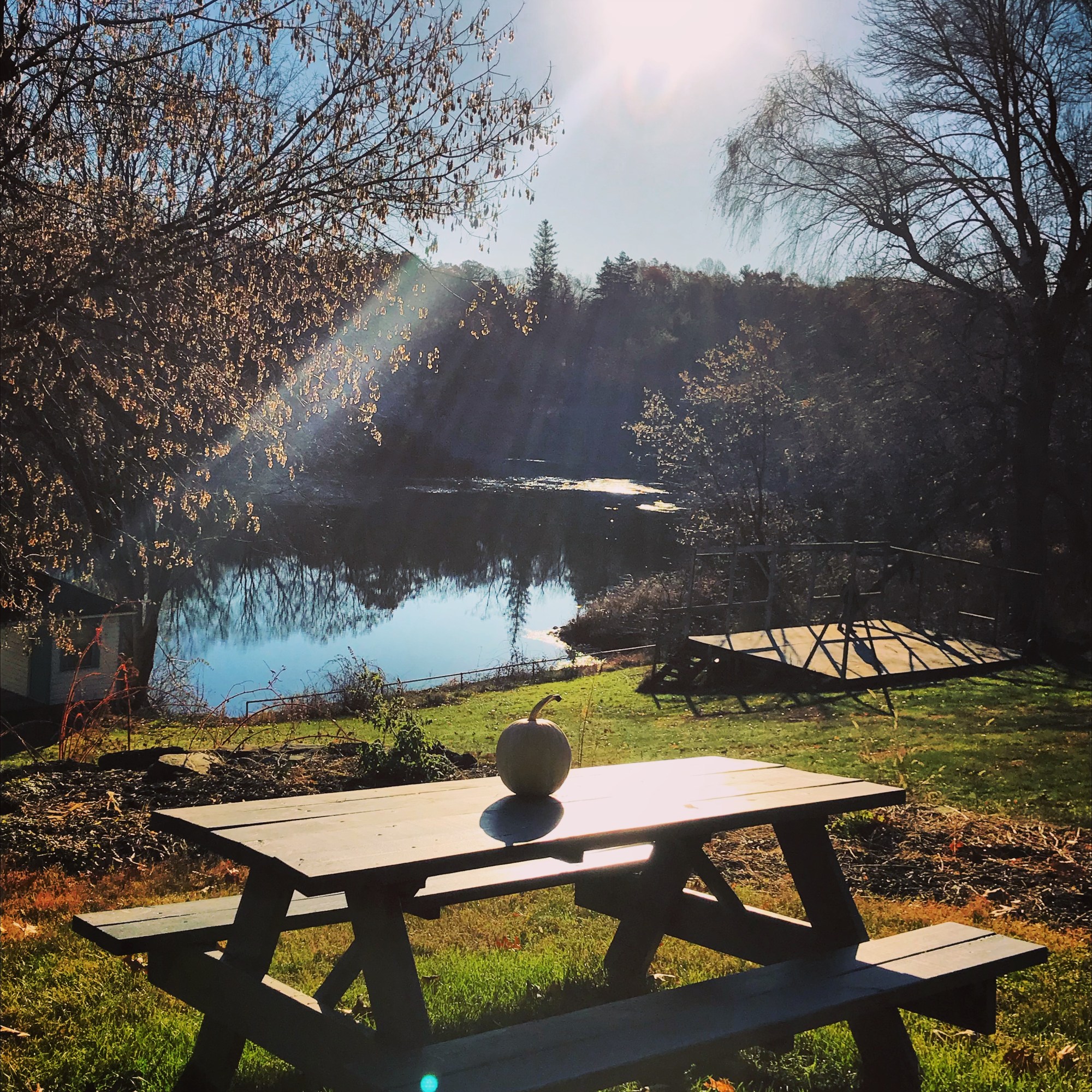
Located in the foothills of the Catskill Mountains, the Ashram provides a serene, natural environment with woods and meadows surrounding a lake. Accommodations are simple and meals are vegetarian.
SAT May 25 8am – 9am Light Breakfast (coffee, tea, toast) 9am Morning Meditation and Fire Ceremony 9:45-10:45 Scripture Studies with Bharati 11:00-12:30 Jivamukti Yoga Asana Class w/ April 12:30-1:30pm Lunch 1:30-3pm Break
2:30-3:00 pm optional walking meditation in woods w/April 3pm – 5pm Jivamukti Yoga w/ April 5:30-630 Dinner 7:30pm-8:30 pm Ashram Meditation Program 8:30 pm North Indian Vocal Concert with Deepak Kumar & Naren Budhakar
This past December I travelled to Australia for the first time. I spent time in Sydney, Melbourne, and the Blue Mountains. I taught some yoga classes, hit up every beach possible, went to art galleries, and went on bush walks. But the only thing I really wanted was to see kangaroo in their natural habitat.
Much like deer in the United States, there is an over-population of ‘roo in Australia, so I didn’t think it would be that hard to do. A friend who lives in the valley of the Blue Mountains told me she has kangaroo in her backyard pretty much all day everyday, so she offered to pick me up from where I was staying and take me to her home. We drove about 40 minutes to her house and were hanging out for about an hour without a single ‘roo in sight. None on the drive there, none in her backyard. I had pretty much given up hope and while my friends went inside for some tea, I decided to walk around the garden. I had been outside for a while, and started to head back in when I saw a flicker in the corner of my eye. I was sure it had to be a squirrel, but when I looked I found an entire kangaroo family in front of me – mom, dad, and toddler joey! I spent a good 15 minutes hanging out with my ‘roo friends before they headed off into the woods. (See video below).
I compared kangaroo to deer in the U.S., and that is pretty much what they are. Although they are not evolutionary related (kangaroos are marsupials), they are very similar; they look at you the same way, live in the same type of habitat, travel with their family, have similar ears, are both herbivores, and, as I mentioned earlier, are over-populated and sometimes a nuisance. Aside from how they take care of their young, there is one big difference – how they move around. While a deer can move forward, backwards, and side to side (although as Bambi has taught us, sometimes quite clumsily), kangaroo can only move in a forward direction. They are completely unable to move in reverse, but they can pivot quickly to change direction with the use of their tail.
Similarly, in our own human lives, we can only move forward. Physically we can move in all different directions – forward, backward, sideways, turn upside down and bend over backwards. Time-wise we can only move forward. Yet many of us are stuck in the past – we ruminate and agonize over things that have happened – words we regret, actions we wish we could change. We even tell ourselves that things will never change – that we will always be miserable, never have enough money, find the perfect partner, always have tight hamstrings (!). We tell ourselves these things as if they were hard truths. When the truth is that everything changes AND we can always pivot in a new direction.
There are many ways to look at the concept of truth, or satya in Sanskrit:
Within the realm of yogic philosophy we are told that the only thing that is True or Real is that which never changes. That there is something within all of us that is a constant, and this is what the quest is within a yogic practice; our Holy Grail; the journey of finding Ātma–bōdha, or Self-knowledge.
In the realm of science there are definitely things that we can take as truth (for now anyway) – the sun rises in the east and sets in the west. The Earth is round; the Earth and the other planets in our solar system revolve around the sun; Einstein’s Theory of Relativity, just to name a few. But even these scientific truths have changed. It was once thought that the Earth was flat, and that the sun revolved around the Earth. As science progresses, what we once thought of as truth is suddenly not. What I am absolutely sure of is that it cannot be proven that you will always be miserable and that your hamstrings will always be tight…
In a relative sense, in our everyday lives, EVERYTHING CHANGES. Our bodies change, our hair changes, clothes, jobs, the people we hang out with, life situations, our āsana practice, EVERYTHING CHANGES. And although we can’t change something that has already happened in the past, the truth is we can make different choices in the present moment. If we are not happy with something in our lives, if we recognize that something needs to change, but we feel like it never will, then that is the first step! Hopefully making choices that are the benefit to ourselves and others.
I’m not saying this is an easy thing to do. Most of us don’t like change – it is hard to let go, even of misery, and is very often painful, but this challenge is what allows us to grow. In every single yoga āsana we are moving in opposing directions. In tāḍāsana (mountain seat), we are grounding down to lift up taller; in utthita parsvakonāsana (extended angle), we are pushing into the back leg while our top arm and the crown of our skull (amongst other things happening) are reaching forward. It is the opposing directions that allow us to feel expansive and grow. Similarly, in life, we are often pulled in opposing directions. We are trying to make changes and move forward, but are being dragged back by those incessant thoughts of the past. It is within this challenge that we can find growth, and maybe discover new truths. Just like a kangaroo, we can pivot, and then keep moving forward.
The other day I was on the train with a large group of teenage boys who were extremely loud. I aware of how loud it was, but wasn’t disturbed by it; it was just there. And then all of a sudden they all got off the train at the same stop and there was complete silence. It was absolutely glorious. The BEST FEELING EVER. It was that same feeling we have after we stop chanting and the words stop but you can still feel the vibrations. Or those moments when meditating when you don’t realize you were in it until you are taken out of it.
I imagine this is what finding yoga/samadhi/enlightenment/Ātma Bodha, whatever you want to call it, is like. (I say imagine because I’m not there yet.) That Ātma, our highest Self, is always there, but there is all this noise – our thoughts, our worries of what already happened and what we think will happen, this crazy world around us – covering it up. We are all already enlightened but it’s being masked by the noise of life. Like how the sun is always present, but some times it’s covered by the clouds, and especially in the winter, we forget it exists. Eventually the sun comes out and we remember the joy of sunshine. Eventually, through long, consistent yoga practice, the noise is drowned out. It’s still there – the boys were still making noise, it was just muffled out by the closed doors – but we aren’t affected by it as much. We are able to move around amongst this noisy world but in a way that we are acting for the benefit of all beings and not just reacting to the noise. We find Ātma Bodha; Self-Knowledge.
First…Thank you Radiohead for your entire catalogue of music, and for the title of this blog post 😀
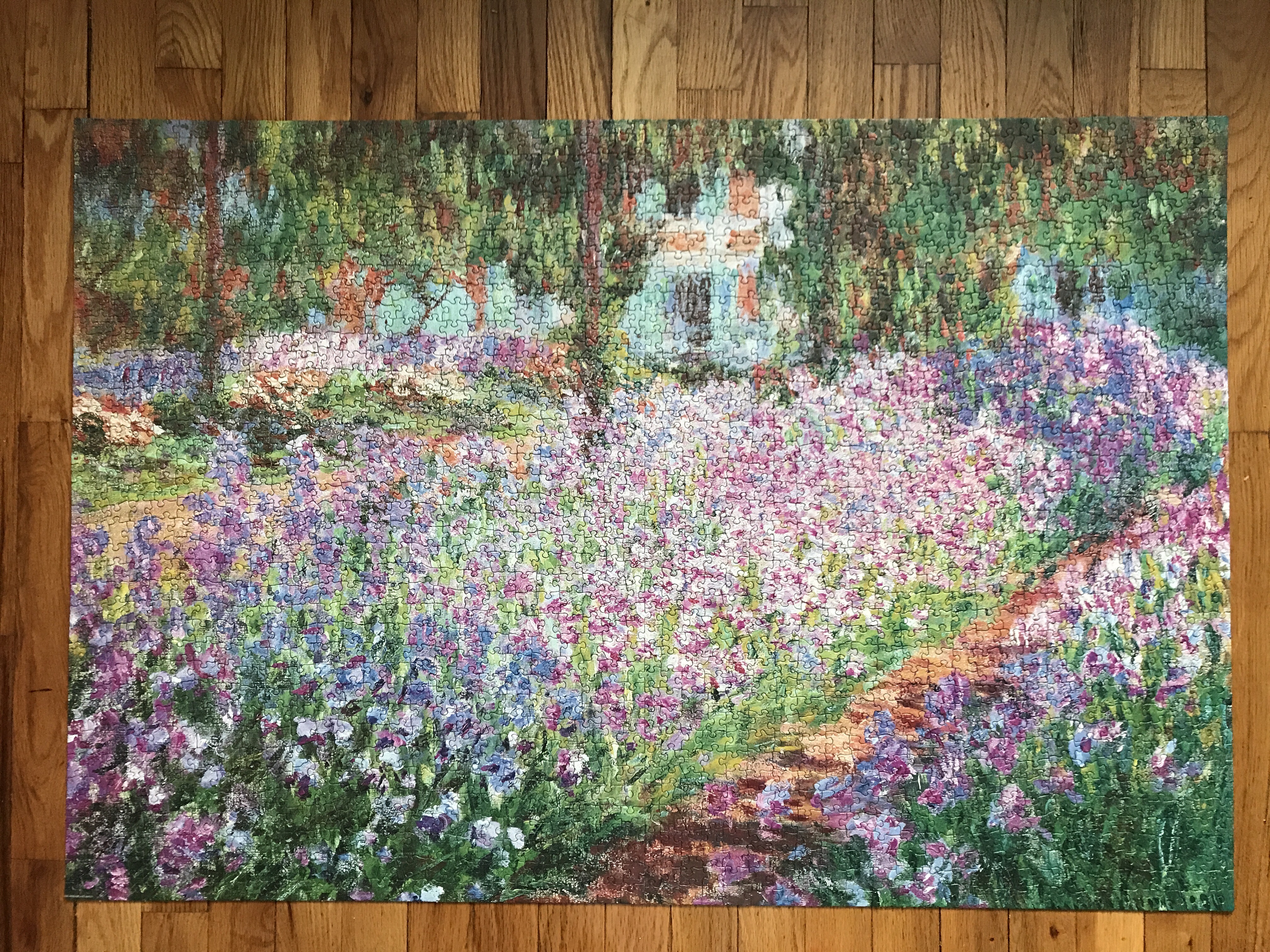
I have a slight addiction to working on jigsaw puzzles. Really CHALLENGING jigsaw puzzles – usually about 3000 pieces, but they have to be minimum 1500. Working on jigsaw puzzles allows my brain to work in a different, meditative, and creative way. I often come up with dharma talks or sequencing while puzzling! The one I finished this morning was 2000 pieces, but is of Monet’s Garden (pictured below), so it might as well have been 5000 pieces. Side note – Barnes & Noble carries a 5000 piece Ravensburger, my favorite brand (yes I have a favorite brand of puzzle), but it is like $85. I am obsessed, but not crazy – I refuse to spend this on a puzzle!
When I am working on a puzzle, and have been looking for a specific piece for a long time without success, I’ll start looking for something completely different. And then, all of a sudden I find what I was looking for in the first place, and it is usually, literally, right under my nose. Or, if I have been sitting in front of it for a while without finding any piece at all, I walk away and do something else. Then when I come back, I often find about 20 pieces immediately.
One of my teachers, Ruth, says that one of the results of a yoga practice is that your vision changes, and when you look at anything you are able to see the whole picture – the past, the present, and the future. You are able to see where things have come from and where they are going.
In our āsana practice, over time, you might realize that the poses we come into all link to each other, just like a puzzle, or that they strategically build up to a more challenging pose later on, the bigger picture. Or maybe you one day realize that all of the poses are exactly the same, just take on a different form! (The truly bigger picture!)
When you are faced with a challenging situation in your life, whether it is personal, or with another person, or more national or global, you may start to see how all of the actions, or karmas, you have taken so far have led up to this point, and how whatever you are about to put into the word as a reaction to this situation will lead to other future karmas. So how you act will affect not only you, and the immediate person/situation in front of you, but the greater world as well. Maybe if you start to look at the situation from a different perspective, from the other person’s point of view, or walk away for a bit and come back, you’ll get what you wanted in the first place, and all of the puzzle pieces fall into place…
Maybe your vision expands so much that, as Ruth says, when you are in the grocery store and you see the non-biodegradable plastic bags that are there for you to put fruit and vegetables in, you can see that they end up buried in the Earth, or in our oceans, and that this causes the Earth and oceans to become sick, and then all of the living begins on the planet become sick. Or when you look at paper plates, cups, napkins, etc., you can picture the trees they came from, and how when we cut down all those trees, it leads to global warming, because there are less trees to take in the carbon dioxide we are emitting, which they then turn back into oxygen, for us to breath, and also to go back into the atmosphere creating rain, which in turn allows everything to grow again. A lovely mandala of life.
The mysteries of the universe often feel like one big jigsaw puzzle, but if we pause for a moment and take it piece by piece, and in the process set an example for others to follow, then slowly, maybe over many lifetimes, the jigsaw will fall into place.




 april dechagas